Which AI agent deserves a place in your business?
MausBot versus OpenBot versus Grok Bot. Who’s the winner? The answer starts with the job you need done.
A developer coordinating several agents needs something different from a business owner scheduling a daily customer report. Someone who wants a cloud assistant running while their laptop is closed has another priority. All three products belong in this conversation, but the same feature list will not settle all three decisions.
Our starting picks: OpenBot for a configurable agent workspace, MausBot for connected business routines, and Grok Bot for a managed cloud computer. We based these recommendations on published capabilities; we have not run a controlled performance benchmark. Product details were checked on October 30, 2026.
Watch the four-minute comparison using the play button on the featured image, or read on for the provider and cost details.
The comparison at a glance
| Platform | Best starting point | Trade-off to check |
|---|---|---|
| OpenBot | Persistent agents, project files, and handoffs across a working team. | Provider configuration and commercial licensing. |
| MausBot | Connected apps, scheduled tasks, and recurring business workflows. | The selected engine determines provider support and billing. |
| Grok Bot | A managed cloud environment that can keep working without your laptop. | Automatic model selection rather than a customer-controlled model picker. |
Those distinctions follow the products’ own descriptions: OpenBot’s workspace, MausBot’s app and automation features, and Grok Bot’s cloud environment. They are useful buying criteria, not evidence that one platform completes every task better.
OpenBot: a workspace you can shape around the project
OpenBot presents agents as persistent teammates with their own working context. Shared files and handoffs make it an interesting starting point for work that moves through several stages: research, implementation, review, and delivery. It supports multiple agent systems and compatible model endpoints, including local options. See OpenBot’s supported setup.
For a website project, we would test whether one agent can investigate an issue, pass useful evidence to another, and leave a change that a person can review. The quality of that handoff matters more than how many agent windows fit on a screen.
Compared with MausBot, our reason to start here would be the project workspace. Compared with Grok Bot, it would be control over the agent and model setup. That flexibility also means someone has to maintain the configuration.
Check the license before putting it into a business workflow. The current OpenBot repository lists PolyForm Noncommercial terms and directs commercial users to obtain a separate license. Do not assume that publicly available source code means unrestricted business use. Read the current repository terms.
MausBot: start with the recurring business task
MausBot’s connected apps, schedules, and event-driven tasks make it worth considering for ongoing operations. Its published examples include business services such as Gmail, Slack, and GitHub, with local or external computer options. See MausBot’s workflow features.
A useful first assignment might be a morning summary of customer requests, a weekly research brief, or a draft report assembled from approved sources. Start with a task you already understand so you can tell whether the result is complete.
OpenBot also deserves consideration for repeatable work; this is not an exclusive feature boundary. Our preference for trying MausBot first would come from how its integrations fit the particular routine. Grok Bot may be simpler when the main requirement is a managed computer that stays available.
Pay attention to MausBot’s engine choice. A connection configured for one engine does not automatically configure every other engine, and model access can depend on that engine’s account or API setup. The engine documentation explains those differences.
Grok Bot: a computer in the cloud, with fewer model controls
Grok Bot provides a persistent cloud environment with a browser, files, and a terminal. It can continue working when your own computer is off. That is a substantial convenience if you do not want to manage a local always-on machine. See the Grok Bot overview.
Grok Bot is not limited to a single Grok model. According to xAI’s FAQ, it automatically selects from first- and third-party models. The limitation is who makes that choice: there is no user-facing model picker or way to route a request to a particular model. Read xAI’s model-selection explanation.
The same documentation says bots in an account share a computer, including files and browser sessions. Separate bot names should not be treated as separate security boundaries. That matters when you are deciding which customer accounts and documents belong in the environment.
We would choose Grok Bot over a more configurable alternative when the managed environment saves enough setup and maintenance time to justify its plan and usage limits. We would look elsewhere when choosing the exact provider is a requirement.
Where OpenRouter, DeepSeek, and MiMo fit
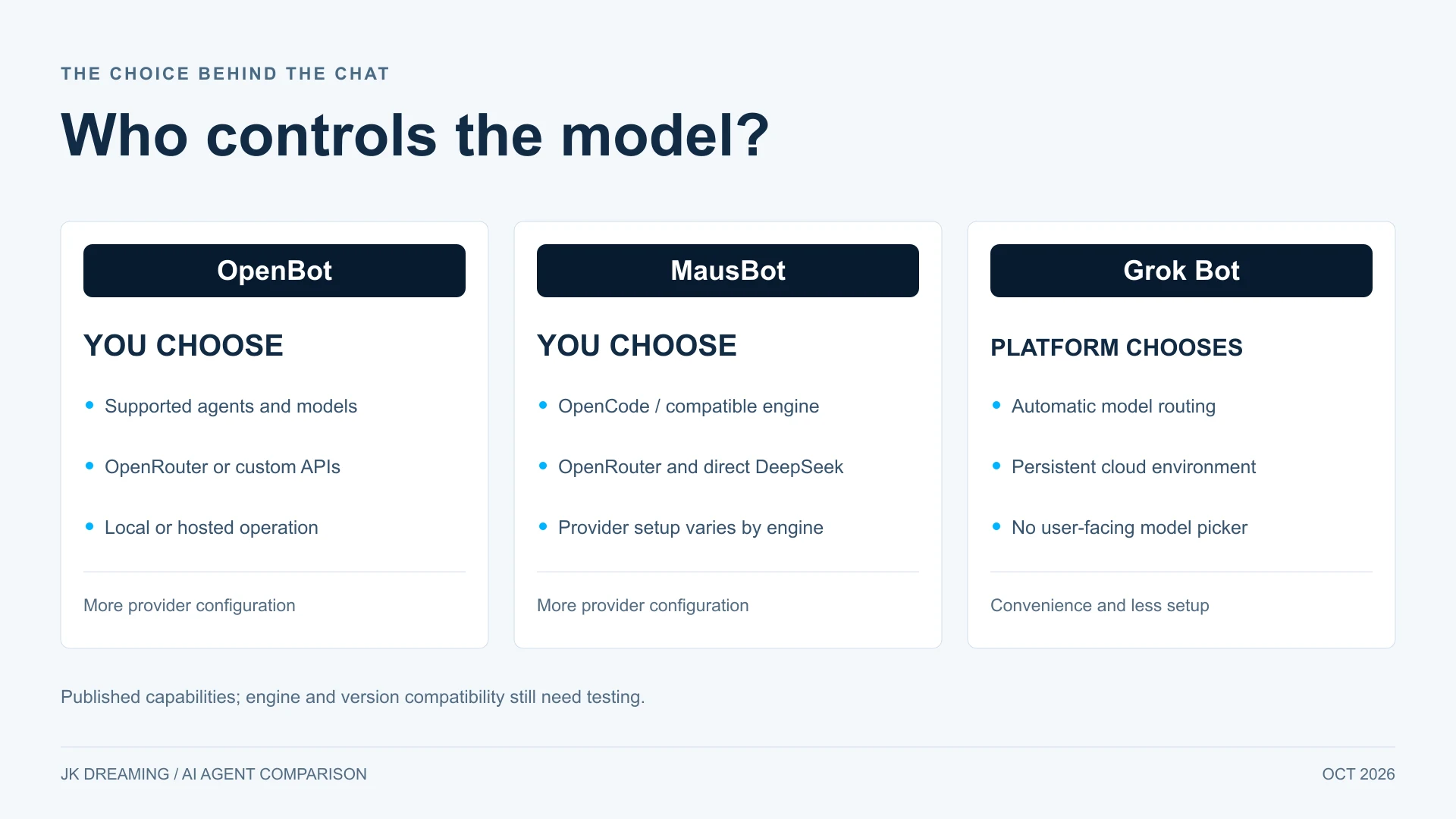
The agent platform organizes the work. The model supplies the reasoning and generated output. Keeping those choices separate can give you room to reduce costs, but only when the platform and engine support the provider’s tools and API behavior.
OpenRouter offers access to multiple models through one service. A direct connection to DeepSeek or another compatible provider removes that routing service from the request path. Compare the actual prices, fees, limits, and supported features of both routes. Neither route is automatically the cheapest for every job.
Xiaomi MiMo is another candidate to evaluate. Confirm its current model identifiers and integration requirements before configuring it; “OpenAI-compatible” alone does not prove that an agent’s tool calls, browser actions, or long-running tasks will work correctly.
For OpenBot: test a cheaper model on a bounded job
OpenBot’s compatible-endpoint support gives you a route to investigate OpenRouter or a direct API provider. Start with extraction, classification, or a short draft where a person can quickly judge the result. Try DeepSeek or MiMo only after checking compatibility with the chosen agent runtime. Keep a stronger model available for work where the cheaper one repeatedly needs correction.
The benefit would be control over what you spend on each kind of work. The cost is the time spent configuring and checking that choice. Endpoint support is not a promise that every model behaves identically.
For MausBot: choose the engine before the provider
MausBot’s provider guide explicitly documents OpenRouter and direct DeepSeek connections through supported OpenCode and chat-engine setups. Support differs elsewhere; do not assume that changing a provider setting reroutes a Codex or Claude Code bot. A custom compatible service, potentially including MiMo, needs its own compatibility check. Follow the current provider-by-engine instructions.
Recurring tasks are a sensible place to measure savings because they repeat. Compare several complete runs, including failures and human corrections, before making the cheaper provider the default.
For Grok Bot: evaluate the managed service as a whole
The documented interface does not provide customer-selected OpenRouter, DeepSeek, or MiMo routing. You therefore cannot make the same provider swap described above. A future bring-your-own-provider option could add useful cost control, but that is a suggestion, not a published capability.
If provider choice is essential today, test OpenBot or a supported MausBot engine. If convenience matters more, compare Grok Bot’s total plan cost and task allowance with the time you would spend maintaining the alternative.
Judge the cost of a finished task
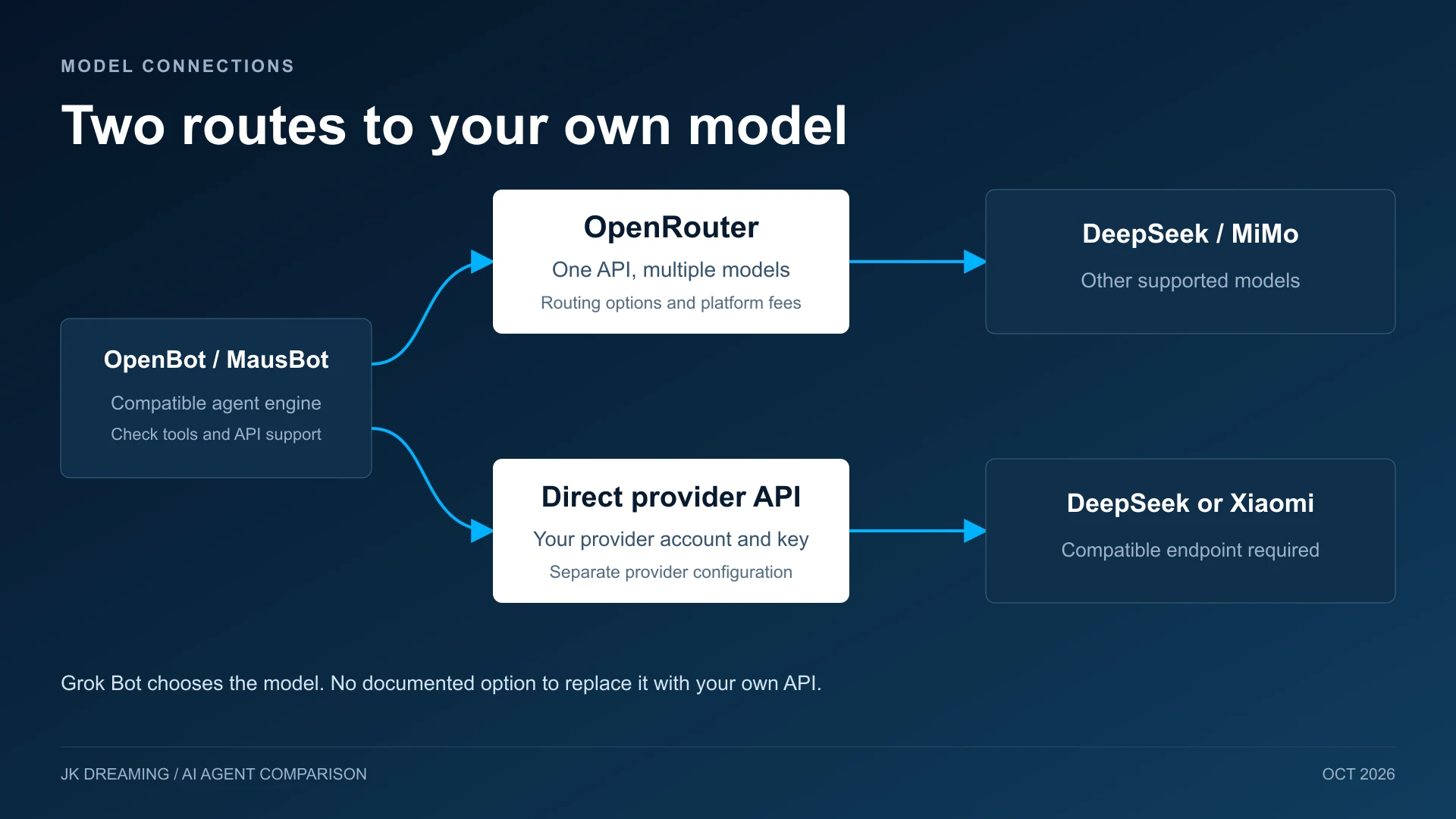
A low token price looks less attractive when a bot retries the same action, loses context, or produces work you have to redo. Count model usage, platform fees, any hosted computer, commercial licensing, and your review time.
For example, ask each candidate to produce the same weekly report from the same approved inputs. Record whether it finished, which facts needed correction, how long review took, and what the whole run cost. Several representative runs will tell you more than one impressive demonstration.
Apply the same standard to all three platforms. OpenBot’s flexibility has a configuration cost. MausBot’s recurring workflows still need monitoring. Grok Bot’s managed environment has value even if you cannot choose its model.
So, who wins against Grok Bot?
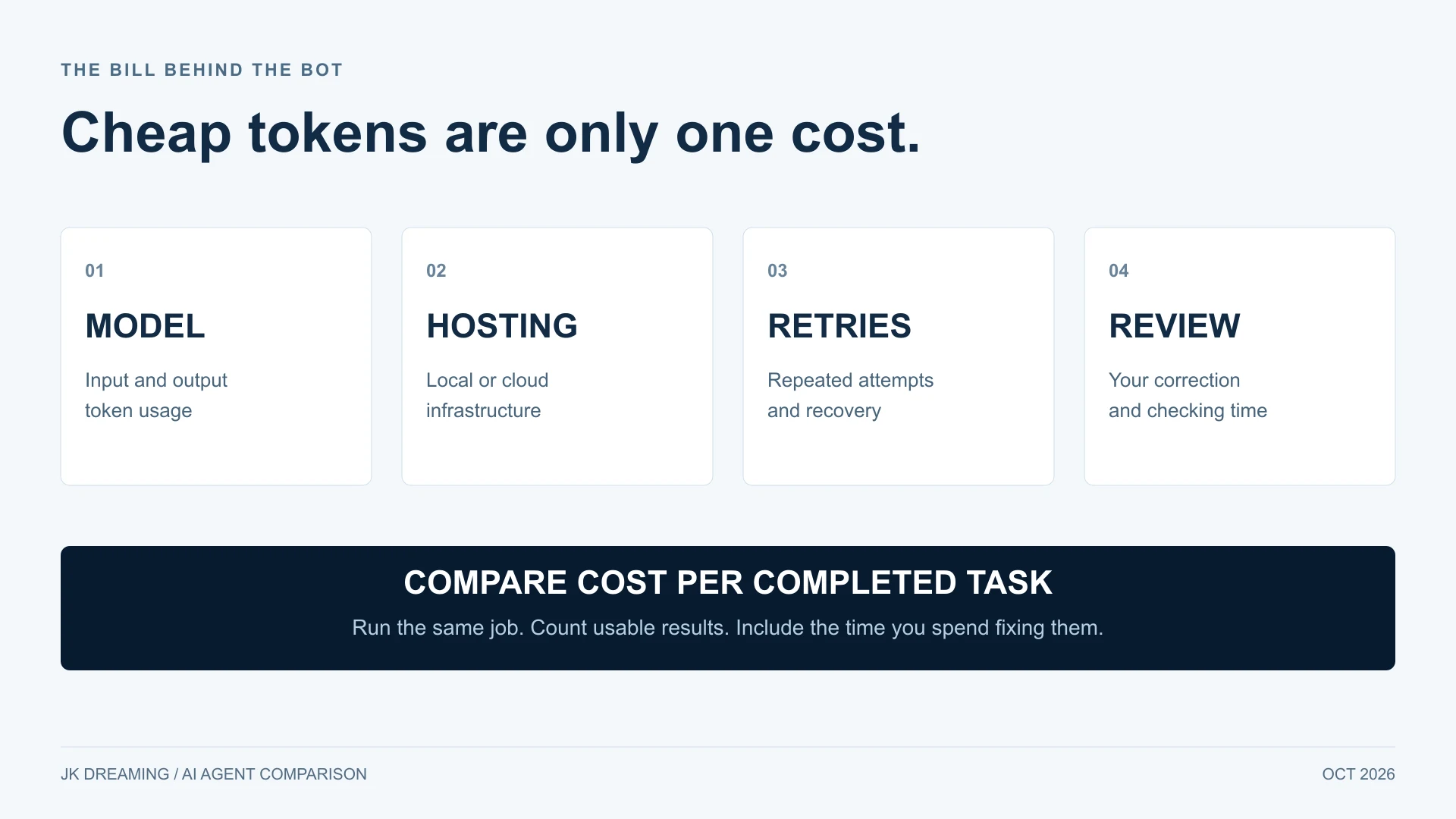
OpenBot is our starting pick when the project workspace and provider control come first. Check the commercial terms and prove that your chosen agent can use the model you intend to pay for.
MausBot is our starting pick for recurring work across connected business apps. Choose the engine deliberately, then test its supported OpenRouter or direct-provider setup against the actual routine.
Grok Bot is our starting pick for a managed, persistent cloud computer. Its case is strongest when the time saved on setup and maintenance outweighs the value of choosing the model yourself.
For a business determined to experiment with cheaper DeepSeek, MiMo, or OpenRouter models, we would investigate the configurable platforms first. For someone who wants to delegate a task without maintaining that setup, Grok Bot belongs on the shortlist.
Pick one real task, define what a good result looks like, and compare the completed work. That is how you find the winner for your business.
Need help deciding where AI fits in your website or business workflow? Talk with JK Dreaming. We help you make informed decisions.